
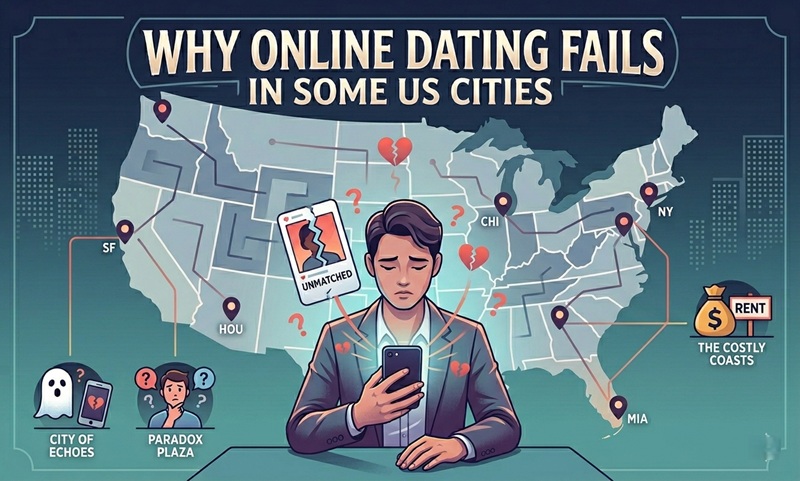
Why Online Dating Fails in Some US Cities (And What to Do About It)
You’ve got a solid profile, decent photos, you’re swiping consistently — and nothing is happening. Before you assume it’s you, consider this: the city you’re in might be working against you.
Online dating doesn’t perform equally across the US. Geography, demographics, and local culture all affect how well apps convert to actual dates.
Reasons Online Dating Fails in Certain Cities
1. Oversaturated Markets
In major metros like New York and Los Angeles, the dating pool is enormous — which sounds like an advantage. In reality, it means extreme choice paralysis. Users swipe endlessly, match rarely, and ghost constantly. The sheer volume makes genuine engagement rare.
2. Low Population Density
In smaller or more spread-out cities like Jacksonville or Oklahoma City, there simply aren’t enough active users on most apps. Match rates drop, and the limited pool means you’re seeing the same profiles repeatedly within weeks.
3. Cultural Mismatch With App Format
Cities with strong community cultures — think smaller Southern cities or college towns — tend to favor in-person socializing. The transactional feel of dating apps clashes with how people there actually connect.
4. App Fatigue Is Real
Research consistently shows that dating app burnout is accelerating. In cities where social alternatives are rich (Austin, Nashville, Denver), people cycle off apps faster because they have better options.
Cities Where Online Dating Underperforms
| City | Main Problem | Better Alternative |
|---|---|---|
| Los Angeles | Oversaturation, ghosting culture | Social events, classes |
| New York City | Choice paralysis | Neighborhood socializing |
| Jacksonville, FL | Low user density | Community groups |
| Salt Lake City | Cultural/religious mismatch | In-person community events |
| Smaller Texas cities | Preference for in-person meeting | Bars, church events, civic groups |
Expert Insight
Dating apps are optimized for engagement, not relationships. Their business model benefits from you staying on the app, not from you finding a partner. Cities with active offline social scenes produce better relationship outcomes precisely because in-person connection is harder to fake.
What to Do Instead
- Treat apps as a supplement, not the main strategy
- Find recurring social environments (classes, leagues, clubs)
- Invest in your local neighborhood — know your coffee shop, your gym, your bar
- Attend events where shared interest already filters for compatibility
FAQs
Q: Which dating apps work best by city? Hinge tends to perform well in educated urban markets. Bumble has strong user bases in Southern cities like Austin and Dallas. Tinder skews younger and works best in dense metros.
Q: Why do I keep getting matches but no dates? This is extremely common and usually reflects ghosting culture rather than personal rejection. It’s worse in cities with large, saturated dating pools.
Q: Is online dating worth it in 2026? As part of a broader social strategy, yes. As your only approach, no — regardless of the city.
Conclusion
Online dating is a tool, not a solution. If it’s failing you, the fix might not be a better profile — it might be stepping back from the screen and investing in your local social life. The cities where people are happiest dating are almost always the ones with the richest offline options.
